Wednesday, 23 November 2016

Sunday, 22 August 2010
Peru has fastest growing economy in Western Hemisphere.

THE QUESTION IS WILL THE WEALTH TRICKLE DOWN TO THE POOR?
The United Nations Fund for Children (UNICEF), warned in a study of poverty in Peru reaches 78% of the indigenous population between 3 and 17 years, compared with 40% of those with Castilian as language.
"The disadvantage is accentuated in the jungle native groups, which concentrate the bulk of negative indicators in terms of poverty, education, identity and health," said the AP on Thursday the UNICEF representative in Peru, Paul Martin.
"He notes that there are inequities between speaking and indigenous children, but there are also differences between the Quechua and Aymara indigenous children compared with those of the tribes in the jungle," he said.
"The study shows that part of Peru's human capital is wasted. Besides the legal arguments to improve is a good economic argument for investing in Indian children, "he added.
The research, which used official figures between 2007 and 2009, indicates that indigenous people in Peru over 4 million, of which more than one million are children and adolescents.
Not specified the number of children and adolescents with Castilian as their mother tongue.
SERIOUS PROBLEMS
The figures show that more than half of Indian schools do not have water, electricity or drainage. An example of these shortcomings are schools Yine natives who live in gas-bearing province of La Convencion, Loreto and Ucayali.
Research shows that lack of identity documents, which hampers the precise social assistance programs is higher in the indigenous jungle. The Ashaninka, the largest ethnic Amazon has 25% of children aged between 3 and 5 years with no birth certificate.
Health facilities in areas where indigenous children live, usually remote, have problems with supply of health professionals despite the state cover increased health insurance since 2007.
The UNICEF representative in Peru recalled that motherhood is more common among adolescents of different ethnic groups of the forest, compared with adolescents Quechua and Aymara.
According to official figures there are 43 languages in Peru Andean and Amazonian grouped into 19 language families.
The United Nations Fund for Children (UNICEF), warned in a study of poverty in Peru reaches 78% of the indigenous population between 3 and 17 years, compared with 40% of those with Castilian as language.
"The disadvantage is accentuated in the jungle native groups, which concentrate the bulk of negative indicators in terms of poverty, education, identity and health," said the AP on Thursday the UNICEF representative in Peru, Paul Martin.
"He notes that there are inequities between speaking and indigenous children, but there are also differences between the Quechua and Aymara indigenous children compared with those of the tribes in the jungle," he said.
"The study shows that part of Peru's human capital is wasted. Besides the legal arguments to improve is a good economic argument for investing in Indian children, "he added.
The research, which used official figures between 2007 and 2009, indicates that indigenous people in Peru over 4 million, of which more than one million are children and adolescents.
Not specified the number of children and adolescents with Castilian as their mother tongue.
SERIOUS PROBLEMS
The figures show that more than half of Indian schools do not have water, electricity or drainage. An example of these shortcomings are schools Yine natives who live in gas-bearing province of La Convencion, Loreto and Ucayali.
Research shows that lack of identity documents, which hampers the precise social assistance programs is higher in the indigenous jungle. The Ashaninka, the largest ethnic Amazon has 25% of children aged between 3 and 5 years with no birth certificate.
Health facilities in areas where indigenous children live, usually remote, have problems with supply of health professionals despite the state cover increased health insurance since 2007.
The UNICEF representative in Peru recalled that motherhood is more common among adolescents of different ethnic groups of the forest, compared with adolescents Quechua and Aymara.
According to official figures there are 43 languages in Peru Andean and Amazonian grouped into 19 language families.
Wednesday, 21 July 2010
MICRO FINANCE - Arriba Ya (a new departure)
"Micro Finance" and "Micro Economic Development" are popular catch words these days. But they were unknown in 1975 when our founder first tried making loans to the same people who are now the bulwark of 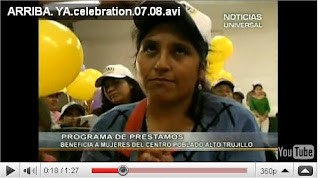 the thousands of NGOs and little banks which offer micro credit. In 1975 our founder was laughed off of Wall Street for trying it. Along came Muhammad Yunus
the thousands of NGOs and little banks which offer micro credit. In 1975 our founder was laughed off of Wall Street for trying it. Along came Muhammad Yunusand taught us all how to it right.And now - at last - we too are doing it right.We are even experimenting with minor advances on the core Graneen system: we have found a way to help extremely poor women gain acceptance as respected clients of High Street Banks. Arriba Ya


Loving Peru

Nicolas creciendo, pensamos en el futuro de nuestros nietos, sembrando para ellos un planeta verde y que ayudemos a todos los niños a salir adelante dandoles educación que es lo que nos hace grande y los de extrema pobreza que tenemos en nuestro pais puedes verlo en Loving Peru
Life is so much more productive when you already have a good plan.
 I said to myself: "Decide early what you want to spend your time doing: what you want to accomplish. Make it something good - for others, preferably those unlikely to realize it without some collaboration - you collaborate".
Trans-America Trek reaches Trujillo (from Montreal)

From left: Iain (VP Bruce Peru, Jean-Francois (Trans Am Trek), Bruce (founder)
STREET KIDS - over 100 million of them. Update.
 All alone a street kid has few positive options; so we befriend them, help them get educated: some do succeed. We know. Just ask GOOGLE to tell you " HOW TO EDUCATE STREET KIDS " and you will meet a fair few of ours in a number of countries
 Here, this is for you - put it on your Desktop. That's where I discovered it, on mine. Must have been put there by one of my IT friends when he was servicing my PC. I am glad he did. And whenever you feel that you are not up to doing something, or for whatever reason you are just not good enough: click on this.
Another last chance - or a 7 day opportunity
Monday morning 4:53AM - In front of another week, a seven day opportunity to accomplish something important [actually writing this for myself, but you can read it]. Must do something each day to advance the bigger goals - don't let the day to day chores distract you from the priorities. Yes.
Divertamento - a little spice in life.
 A little History, Geography, Current Events, economics, prejudice and a pinch of irony, stir lightly, waft through a hot wok and serve as a Majon Cartoon.
"MAN MADE ME D IT"

LIFE - What are you going to do about it?
 Dear Friends, We are born, we die: the world blinks and goes on. Our current priorities evaporate when we go. I challenge you to stand all this on its head - from now on the only priority:
 MY PRESENCE SHALL MAKE A GREAT POSITIVE IMPACT.
Remembering you while we are away


Of liars and global warming deniers
 So, if global warming deniers are just being selfish - because they see what's coming but pretend they don't so they will not have to do something about it. And secretly they are counting on man's ability to engineer his way out of trouble to get us out of this one too. But just suppose the person we are all depending on to design and invent, organise and lead us all out of the coming doom just happens to be one of these deniers
Sunday, 20 December 2009
Christmas 2009

This years Christmas party, while more compact than usual (fewer than 200 children invited) nonetheless seemed the happiest in memory. For the first time each school dawned special costumes which they had made and sang their favorite Christmas songs. The competition was fierce but two Miss World contestants had little trouble separating first and second place from
the competing choirs of our shanty schools from the barrios of Trujillo. This year we hosted Christmas parties in our schools throughout Latin America in 13 cities from Panama to Bolivia. Our impact this year has been greater than any previous, and we accomplished this on our smallest budget in awhile. Though not a religious organisation we still must acknowledge the many many answered prayers which has seen our mission through to the end of 2009. We must also acknowledge the tireless work of our wonderful dedicated staff. And our teachers, both our own and those the Ministry of Education are now providing to more and more of our schools. We have unsung heroes in cities we can only get to about twice a year, teachers who implement our programme as strictly and well as any of our headquarters schools - they recruit semi abandoned children and train them up to be exemplary pupils. We are grateful and honoured to be able to participate in this rewarding work.
Subscribe to:
Posts (Atom)